We all probably know by now that although marketing once entailed businesses delivering certain advertising messages to consumers, marketing now describes a two-way relationship between brands and customers. Influencer marketing has become a prominent strategy for companies to strengthen these consumer relationships as well as their brand identity, because of its word of mouth recommendation power.
In today’s article, I wanted to share some best practices on how to start an influencer marketing campaign. Make sure to check out last week’s post on what influencer marketing is and why it’s important for strong branding for a greater understanding of what all an influencer marketing campaign might encompass.
1. Finding the Right Influencer(s)
Your company should already be well aware which social networks are the most effective for your brand. Do the influencers you’re considering also have a strong presence on these platforms?
Choosing an influencer with the greatest amount of followers isn’t always the best strategy to follow. Understanding their engagement levels and overall influence on buyers’ purchasing decisions is important. (After all, you’re trying to adopt some consumers they have a strong relationship with as well.)
Identify individuals in a related niche with similar target markets. Is their brand more or less consistent with yours?
Consider whether location is a significant factor to account for as well, depending on the types of products or services you offer.
2. Decide the Best Way to Collaborate
Do you need an influencer to feature your products or services on their accounts?
Are you looking for more of a spokesperson for your brand? Will they help you host events or take over your social media stories?
Will you allow them to have creative freedom or will you provide them guidelines or a script?
3. Choose a Form of Compensation
There are many ways to compensate influencers for their collaboration, whether that be directly with cash or through product or service rewards. Below are a few ways to reward influencer marketing relationships:
Pay per post – just as it sounds, pay for every post created
Contracts/campaigns – partner with these influencers for longer-term promotional campaigns
Free products – some individuals may even mention your brand as a thanks for a free product or service
Ambassador programs – individuals are paid as brand sponsors
Affiliate programs – brand affiliates typically earn rewards and commission based on their sales efforts
Finally, reach out! But make sure to define campaign goals and implement ways to track success ahead of time.
Developing an influencer marketing campaign doesn’t have to be a complicated process if your company knows who to look for. Some best practices on how to start an influencer marketing campaign include finding the right influencer(s) to work with, deciding on the best ways to collaborate, and choosing how to pay the influencer(s) in return for their work.
I hope this article was of value for you. If you learned anything new, I’d love for you to give it a like and comment down below any of your favorite social media marketing tips. Make sure to stay tuned for more posts regarding digital marketing!
With the continued rise of digital marketing and popularity of various social platforms, influencer marketing plays a prominent role in how businesses can further connect with their customers. Businesses should utilize influencer marketing to help add another dimension to their marketing campaigns and brand overall. In this article, we will explore in greater detail what exactly influencer marketing and branding are and how influencer marketing can play a significant role in brand building efforts.
Brands:
The idea of a brand has evolved from something more tangible, such as a logo helping consumers identify a certain product from another, to now encompassing the entire user experience with a specific product or service. This definition has expanded to include intangible concepts such as reputation and value expectations. Branding is important for several reasons which we will explore in more depth later on in this article. Most importantly, brands are essential for constructing marketing programs.
Influencers:
To fully understand what influencer marketing is, it’s critical to first develop a solid understanding of who influencers are. While not necessarily defined by the amount of followers they maintain, Influencer Marketing Hub defines “[a]n influencer is someone who has:
the power to affect the purchasing decisions of others because of his or her authority, knowledge, position, or relationship with his or her audience.
a following in a distinct niche, with whom he or she actively engages. The size of the following depends on the size of his/her topic of the niche.”
Influencer Marketing:
Now knowing exactly who an influencer is, we can begin to understand what influencer marketing entails. Sprout Social describes influencer marketing as “a type of social media marketing that uses endorsements and product mentions from influencers…Influencer marketing works because of the high amount of trust that influencers have built up with their following, and recommendations from them serve as a form of social proof to your brand’s potential customers.”
In other words, influencer marketing entails companies utilizing an influencer’s “influence” in the consumer decision making process with an already established audience in order to promote their own products or services. Influencer marketing approaches promotional campaigns in both a unique and highly collaborative way, which is why it’s becoming an increasingly popular strategy for marketers.
Influencer Marketing In Today’s Landscape
Influencer marketing isn’t limited solely to celebrity endorsements, which were popularly used in traditional marketing campaigns. It works well because consumers tend to trust the influencers they follow, especially those “micro”-influencers who don’t have as hefty of a following compared to celebrities who may be seen as promoting certain items inauthentically. Influencer marketing serves as a glorified version of electronic word of mouth, to put it simply.
Using influencers in marketing campaigns became more and more prominent with the rise of YouTube, where ordinary users made a name for themselves while sharing their hobbies and talents with others. I explored this topic more in a previous post relating YouTube and influencers, which I’ll have included here if you want to go back and read it. I quickly wanted to re-explore one of my favorite instances of influencer and brand relationships, in order to provide the best understanding of this trend.
Bethany Mota is a beauty, fashion, and lifestyle vlogger who found fame early on from YouTube and who has grown with the platform ever since. Growing up watching her videos, I have always been intrigued by how she grew her empire essentially from the ground up. As she became more and more popular, relevant companies began to partner with her in order to be featured in her videos and tap into a new audience. For instance, if Neutrogena sponsored one of her makeup tutorial videos as long as she used their products, Mota’s fans were likely to run out and purchase these items to achieve her same makeup look.
Before diving into how exactly influencer marketing campaigns help to strengthen brands, let’s quickly break down why branding is important. As mentioned previously, marketing strategies cannot be built without having an established brand. Moreover, strong branding results in many rewards for a growing company.
TRUST: One element of branding is a brand’s promise, which helps create an expectation of benefit for customers. When branding is consistent and when customer expectations are consistently met, trust is built and strengthened. Companies must make sure not to lose a customer’s trust, as consumers are not as likely to give second chances.
BRAND LOYALTY: When trust is built between a brand and consumer and a relationship is formed, a company should continuously work to increase brand loyalty. The ultimate goal of a company should be to build a loyal customer base who will go out of their way to purchase the brand they trust. Companies want loyal customers who will not be easily claimed by other competitors.
TOP OF MIND AWARENESS: Strong branding also helps to increase brand awareness and thus top of mind awareness for shoppers. Popular brands with large followings are likely to be more well known than other competitors and thus will likely be considered first in the consumer decision process.
How Influencer Marketing Campaigns Strengthen Brands
Let’s revisit this idea of influencer marketing as a type of eWOM marketing. This is critical. Especially since word of mouth is one of the most effective marketing tools. Just as individuals are more likely to trust product recommendations from their friends or family, people are also likely to trust recommendations from their favorite influencers, or their online friends.
Partnerships with influencers also help to develop a brand’s personality as an element of successful branding. With an already established element of trust between the influencer and their followers, this trust can translate well to brand loyalty with authentic and relevant collaborations. In my next article, I will continue addressing how to develop an influencer marketing campaign, including how to find the right influencers to represent your brand.
Influencer marketing also serves as a way for brands to generate additional branded content. It serves as another form of user-generated content, but is typically more professional. However, influencer marketing could even include brand rep programs, which I’ve also covered in a previous article. This is another great way to rally a community of brand loyal customers while also collecting great amounts of user-generated content.
Influencer marketing has already and will continue to take the business world by storm. Hopping along on the bandwagon will present many benefits for your brand, including strengthening your brand and increasing brand loyalty. Ultimately, partnering with influencers in your company’s promotional strategies will help drive increased brand recognition and sales.
I hope this article was of value for you. If you learned anything new, I’d love for you to give it a like and follow along for next week’s post about where to begin with your influencer marketing campaign. Make sure to stay tuned for more posts regarding social media and digital marketing!
How a company responds to a challenging situation can make or break their business. The major implications the COVID-19 pandemic brings to all companies alike are no exception. This article will cover some current changes in digital marketing trends in response to the Coronavirus.
1. Emphasis On Essential Items
The threat and impact of the Coronavirus on our current economic environment means an even greater and focused demand for essential items. Some consumers might not feel comfortable leaving the safety of their shelter to potentially find the supplies they need from grocery stores. Other consumers simply may not be able to find essential supplies, no matter where they look. Thus, online supply for these items has become a major trend.
For example, customers are turning more towards delivery services for their grocery needs. Moreover, in response to changing demand, Amazon refocused their efforts to supplying essential items first and foremost to their customers. In return, their familiar promise of 2-day delivery for Amazon Prime members for non-essential items has been updated so they can better focus their efforts on meeting the demand for essential household items.
2. Increasing E-Commerce Sales
Businesses were already witnessing a shift to e-commerce, or online sales, before the Coronavirus. However, now that many companies are limited to online services only and many people are ordered to take shelter in place, it comes as no surprise that a great amount of business has moved online.
This shift from offline to online transactions has major implications for a company’s digital marketing strategy. First and foremost, now that several companies exist solely online, they must ensure that their online branding represents their products and services well. They should take care to provide a seamless experience for consumers throughout their digital communication efforts, including their website, social media presence, email marketing campaigns, and more.
Marketers should be aware that, as mentioned previously, consumers are focused more on purchasing essential items than luxury items. This isn’t to say that all non-essential businesses are doomed, but companies should make certain to continue fostering customer relationships and encouraging purchases by targeting the right customers who maintain the budget to purchase these non-essential items and to do so in this season where they have more free time and not much else to do than online shop.
3. Greater Brand Building Efforts
Strong branding is essential for the success of any marketing campaign. With many long-term strategies being revisited or put on pause, this current season provides the perfect opportunity for companies to continue strengthening their brands and consumer relationships. This is critical for small businesses especially.
One of my favorite examples of this comes from an Atlanta based restaurant called Yumbii. Fortunately for Yumbii, the restaurant continues to operate, offering free delivery for orders $25+ within 5 miles of their shop. They also have two locations for curbside pickup. As a thanks for supporting the business, they include a roll of free toilet paper with each order.
Moreover, Yumbii continues to interact with and engage their customers through their website and social platforms in order to provide them with restaurant updates during this time.
Companies are seeing many digital marketing changes in the midst of COVID-19, such as greater demand for essential supplies, a shift to online sales, and a push for greater brand building efforts, to name a few. Businesses should ensure to consistently update and cater to consumers throughout their entire digital marketing communications plan in order to best serve and provide value to customers in this time of need.
If you enjoyed this article and found it to be of any value, please give it a like and share with friends who might learn from it as well! I’d love for you to follow my blog for future posts regarding digital and social media marketing. Feel free to comment below any companies you believe are responding well in their marketing efforts to this pandemic and I hope to catch you in two weeks with a new article!
If you’ve ever considered starting a YouTube channel, whether your own personal account or for your company, then this article is for you! With over six years’ experience on the platform, I might have a tip or two regarding search engine optimization, or SEO, for anyone reading this.
YouTube offers individuals an attractive platform to showcase their passions and visually express their creativity. Companies should consider pursuing a presence on the site to highlight a behind the scenes look into their business ventures, allowing consumers the opportunity to better see a brand personality alongside the company. Moreover, businesses that are more product-focused especially should utilize the platform for tutorial videos or ways to use their products in a new or different way.
1. Keyword Rich Titles, Tags, & Descriptions
With a seemingly overabundant number of users on the platform, YouTube’s algorithm might not seem like an easy one to figure out. However, for smaller channels to even have a chance at standing out on the platform, optimizing content to show up early in search rankings is a surefire way to attract more views.
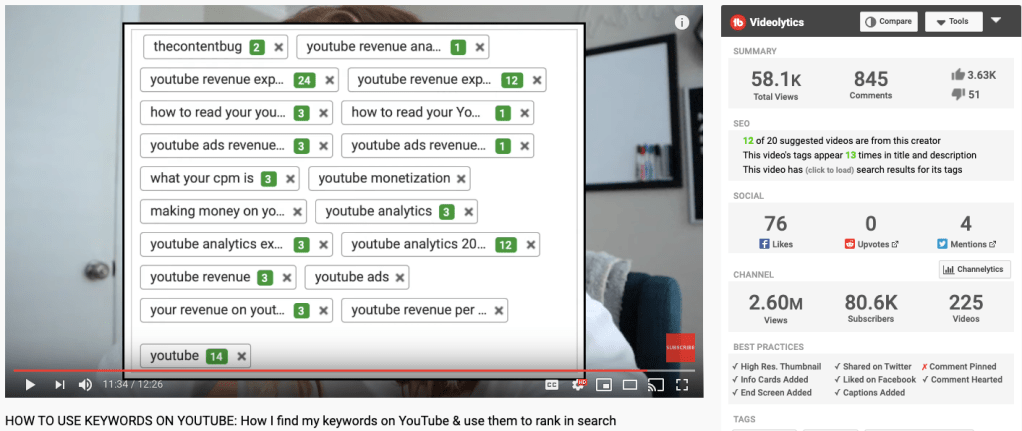
Google provides tools such as Google Trends and Keyword Planner which should be used to discover what content is popular on the platform currently and how users are searching for certain topics. TubeBuddy is also a great extension to use when optimizing keywords for videos (shown on the right hand side of the photo below). Knowing which keywords to use and making sure they remain consistent among your videos’ tags, titles, and descriptions is important for all channels to remember. Moreover, channels competing in a niche category have less competition to rank ahead of.
I love learning more YouTube SEO tips and tricks from Cathrin’s channel TheContentBug which I’ll have linked here. Her channel has grown substantially over the past year as she’s learned more about using the algorithm to her advantage.
2. Deliver Valuable Content
Great! Someone took the chance on your video and started watching. Now what? Audience retention plays one of the most important roles in ranking on YouTube. It’s crucial that you provide valuable content in your video to keep viewers watching. What can viewers take away from your video and how is it different from what competitors have to offer?
3. Clickable Thumbnails
Here’s the harsh reality of this visual platform. You can create professional content full of value for your channel. However, if your thumbnails aren’t enticing enough to catch viewers’ attentions, your content will easily get lost in a sea of other videos, even with highly searchable tags, titles, and descriptions. This isn’t always as easy as it sounds, as YouTube’s click through rate on video impressions averages between 2-10%.
4. Include Captions
Allowing for the option of captions to be displayed during your video can further promote SEO, especially when keywords are included in your audio. YouTube will generate automatic captions for your videos, but it’s always best to review these captions before posting your video. You can even hire someone to transcribe captions for your video if resources permit.
5. Cross Promote
Cross promoting is beneficial on any social platform, YouTube included. Don’t hesitate to include the handles to other social accounts on screen during the video and linked in the description. Moreover, make sure to promote your YouTube channel from any other social sites you’re active on!
Thank you for reading to the end of this article! I hope you learned some valuable information you can use to either start your own channel or continue to promote your brand through video production. Please don’t hesitate to reach out with any further questions you may have. Don’t forget to give this post a like and let me if you or your company run a YouTube channel. Follow my blog for future uploads regarding social media marketing!
One of my best kept secrets when it comes to editing my Instagram stories is doing so within the app. The platform itself offers a plethora of features when it comes to creating stories and enables users to add stickers (which can feature another account, showcase a location, have users participate in a quiz or poll, and much more) and gifs, include text in any color imaginable or using those colors found in the image, draw, and create unique content utilizing Instagram filters and user generated filters. However, there are also many mobile apps outside the platform which I love using to further step up my Instagram story game. In this article, I’ll be sharing my 7 favorite.
1. VSCO
This popular photo editing app enables users to choose from a variety of free filters for their photos, making them seem like an expert photographer and photo editor in minutes. The app also offers an expanse collection of additional filters and editing features to VSCO members for $19.99 a year, as well as the ability to use filters for videos. Nevertheless, another free feature includes a camera effect called DSCO, which is similar to a stop motion graphic.
2. Adobe Photoshop Lightroom
This mobile friendly version of Adobe’s Lightroom Classic is another photo editing app that offers an even greater variety of editing tools then does VSCO. A vast majority of these features are also free. From what I’ve noticed thus far, users are limited when it comes to editing RAW photos without subscribing to the Adobe software plan. Otherwise, Lightroom is another great photo editing option, especially for more advanced users.
3. Fonts
Whoever named this app either seriously lacked creativity or is an honest genius. Just as it sounds, this app offers a greater variety of fonts than Instagram offers natively for users to add text to their stories. It works as a keyboard on your phone, making it super user friendly and easy to use on Instagram and other apps.
4. Phonto
Phonto is a great tool for customizing Instagram stories with text. There are many free fonts to use on the platform and users may also opt to upload their own fonts. The app also provides the capability to overlap images and create designs from scratch.
5. Unfold
Unfold boasts a very trendy design within the app. While it provides many free frames, individuals can opt to pay and unlock more styles. One of my favorite frames offered on the app lets users add their photo into a polaroid frame and add text beneath it if they so wish. With polaroids once again becoming a popular option for film photography, I highly recommend checking out this app for your Instagram stories!
6. StoryChic
I’ve been experimenting with this app over the past month and frequently get asked what app I use whenever I post a design to my Instagram story. The answer is StoryChic! There are many free and cute templates on this app, perfect for bloggers, along with a few animated designs to choose from.
7. mojo
This app is a must for brands promoting their products or services. They offer several free templates for Instagram stories, many of which are animated. Your company is sure to portray an even greater level of professionalism utilizing these Instagram story graphics.
If you liked this post, I’d love for you to give it a like and check out some of my previous articles. What are some of your favorite editing apps? Also, don’t forget to follow my blog for future uploads pertaining to social media marketing!
It comes as no surprise that YouTube is one of the leading social networks to pave the way for marketers to creatively evolve their promotional strategies. Over the past decade and a half, this video streaming platform takes credit for the rise of famous influencers such as Bethany Mota, Felix Kjellberg, and Jenna Marbles, just to name a few. In this article, we will be focusing on Bethany Mota’s unique rise to stardom and how her story, like many others, posed as a new opportunity for marketers to connect their target audiences with their brand.
24-year-old Bethany Mota currently boasts nearly 10.5 million subscribers on her YouTube channel. In her career, she has produced over 500 total videos between her main channel and vlogging channel, she’s released her own clothing line with Aeropostale and a school supplies line featured at Target stores, she participated in a season of Dancing With the Stars, has been nominated for and received numerous awards for her web presence, and much, much more.
Bethany Mota’s story regarding her career success begins with the start of her YouTube channel as an early teen. She began creating videos showcasing makeup and clothing items she recently purchased, and further shared her experience with the beauty, fashion, and lifestyle world. Her content was ultimately relatable to her audience of primarily young girls and she soon became a known name among the YouTube community.
Many people like Mota have found a place for themselves on social platforms as “influencers”. Influencers are modern entrepreneurs who typically promote themselves as a personal brand.
What Does This Mean for Marketers?
With word of mouth remaining the most effective promotional tool for marketers, it makes sense that influencers like Bethany Mota serve as an attractive opportunity for brands to reach consumers. Companies can send free products to influencers in hopes that they might mention the brand on their platform(s) or more directly pay influencers to mention their company through sponsored content.
Here are a few advantages of influencer marketing for brands:
1. Pre-established Credibility
Influencer marketing is relationship marketing. When choosing the right influencer to work with, companies should find an influencer whose personal brand is already in line with the products/services the company wishes to promote. Moreover, this influencer must produce authentic content in order to maintain trust with his or her audience.
2. Increased Brand Awareness Across Multiple Channels
Influencers might naturally favor one platform over another, especially YouTubers who have built their career around the site, but they are generally present on other popular networks as well. Companies can pay influencers to promote their brand on multiple channels to reach an even greater audience.
3. Influencer Generated Content
We all know the power of user generated content for brands (and if not, make sure to check out my blog post on The Marketing Behind Being a “Brand Rep” https://themoresocial.business.blog/2020/02/04/the-marketing-behind-being-a-brand-rep/). The same is true of influencer generated content, which is oftentimes of higher quality and more relevant to the brand. Companies should utilize this content to help further promote their brand.
There is no doubt that marketing has shifted more towards authentic storytelling with the rise of social media. This new outlook on promotional efforts was enhanced with the rise of YouTube and content creators, or influencers, who became their own brand. Modern companies taking the greatest advantage of social media marketing must utilize the opportunities which connecting with these individuals offers them.
If you enjoyed this article and learned something new, I’d love for you to give it a like and check out some of my previous posts. Leave me a comment telling me how you’ve seen your favorite brands use influencer marketing. Also, don’t forget to follow my blog for future uploads pertaining to social media marketing!
What comes to mind when you first think about Coca-Cola? Is it the taste of the soda? The refreshing sound of opening a can on a hot summer day before quenching your thirst? Or perhaps you revisit a sweet memory in which the brand plays some sort of role.
I’m confident that for the majority of you reading this, your recollection of the brand favors more towards what Coca-Cola stands for rather than for the taste of the products they offer. In fact, I recently read an article on the American Marketing Association’s website regarding the failure of New Coke when it launched in 1985. Although studies predicted that consumers should have liked the taste of New Coke better than the existing product, Coca-Cola fans were not as pleased with the company’s decision to replace the original formula, going back on company tradition.
Coca-Cola soon realized that customers didn’t care about the taste of their drinks as much as they invested in the tradition of the brand. The company thus reinstated their hundred-year-old formula and has capitalized on brand narrative ever since. One of their more recent campaigns even promotes consumers to “taste the feeling”.
With the evolution of branding and brand identity comes an even greater push for storytelling in marketing. Whereas the term “brand” used to refer to more tangible products or the services a company offers, the term has now come to demonstrate the intangible elements of a business, such as reputation and the ability of that company to fulfill their brand promise, or the value they claim to offer.
Authenticity and brand narrative remain especially important with the rise of two-way communication as it exists in social media marketing. Since much of social networks typically involve users connecting with other users, it’s safe to say that people are unwilling to connect with a brand that constantly spams followers solely with advertisements about the products or services they provide. Companies must take advantage of the opportunity on the platform to get creative with their content and strive to engage with, rather than just promote to, consumers. Video content and live streaming on digital devices allows for an incredible opportunity for consumers to interact with their favorite brand and get to see the heart of the company. It’s much easier to build brand loyalty with customers when they get to see a real personality behind your brand.
While it may seem like marketing has become much more complex over the years, running a company that evolves on the passions of those who founded it must come first, with the rest following naturally. Many consumers prefer to engage with raw and real content, which is typically much easier to create consistently (another key to successful social media marketing especially) than highly produced content all the time. Don’t be afraid to have personality as a brand. In fact, embrace it! After all, that’s what consumers want to see most.
If you liked this article, I’d love for you to give it a like and check out some of my previous posts. Leave me a comment telling me what your favorite brand is, and what it is that they stand for. Also, don’t forget to follow my blog for future uploads pertaining to social media marketing!
Instagram has quickly become one of the favorite social networks for users all around the globe. The platform’s grid layout and the multitude of features offered on the app provide a fun and attractive space for everyday users and businesses alike. The site has proven beneficial in both B2C and B2B marketing strategies. In this article, we will be going over 3 Instagram tools to help garner exposure for your brand.
1. Stories
First seen on Snapchat, stories enable Instagram users to break free from the seemingly perfect and well curated content provided on the main feed of many accounts. While influencers and other brands are oftentimes encouraged and still seek to produce creative and high quality stories, these quickly disappearing snapshots allow users to see more organic, everyday, behind the scenes, typically raw and real content. Not to mention, users can choose their favorite stories to save as highlights on their main page above their grid, to help better give viewers an idea of what their account is about.
There are many awesome ways for a brand to take advantage of Instagram stories. After all, the platform tends to favor users who participate in the various features offered. For starters, Instagram stories can be used to promote a recent post, advertise a new product, or stir up consumer engagement. A multitude of stickers such as polls, countdowns, location tags, questions, hashtags, mentions, and much more, can be used to decorate stories and start conversation. Location tags, hashtags, and mention stickers are further beneficial because location tags and hashtags are more specific and searchable, and other accounts mentioned in a story can share to their own story, increasing awareness among their own followers.
2. IGTV
As stated previously, Instagram rewards users who utilize features native to the platform. Instagram more recently rolled out their IGTV, which allows for videos longer than a minute to be published to the site. These are commonly used by vloggers to promote videos posted to their YouTube channels, influencers to post product reviews, videographers/cinematographers to provide a glimpse of their work, and more. Users can search for IGTV videos in a separate tab on the discover page.
3. Shopping In Apps
A major social media trend highly beneficial for businesses, especially retail companies, is the ability to embed website links on the site and provide product shopping directly in the app. These posts can be promoted as paid advertisements, or left to be found by users in the shopping tab of the explore page in the app. Companies, however, should beware to maintain their presence on the platform as a way to further communicate with consumers as well as promoting their brand in order to ensure their page does not end up looking like one endless advertisement no one wants to engage with.
Entrepreneurs are known to be opportunity obsessed individuals who are able to implement their ideas in a marketplace in innovative ways. The rising trend of social media marketing for both B2B and B2C strategies allows an additional avenue for entrepreneurs to network with other businesses, connect with consumers, and promote their brand in a rather immediate and global setting. In this article, we will take a look at 5 steps entrepreneurs should pursue in order to take advantage of social networks.
Choose the Best Platforms
Before investing too much time in developing a social media marketing strategy, entrepreneurs should first consider who their target market is, as well as the best channels to reach their audience. While entrepreneurs are encouraged to adopt an integrated marketing communications plan consisting of multiple social platforms where consumers can connect with their brand, there are certainly specific platforms over others where time and resources are better spent, regarding where target consumers are found.
Once the best platforms to reach consumers are chosen, entrepreneurs must keep up conversation with and engage their customers. Every marketing strategy includes the proposition of providing value to customers. With this being said, what better way for entrepreneurs to identify an unmet want or need and market opportunity than by being in constant communication with their target market? Moreover, keeping up with customers plays an important role in branding as marketing now includes a two-way means of communication.
Inspiration & Opportunities
Social networks act as an incredible source of inspiration for new opportunities. Perhaps an aspiring entrepreneur is sorting through many creative ideas, but wanders if these ideas have potential looking forward. Entrepreneurs can take to social media in order to further observe whether or not an opportunity is truly present, or if the market for this want or need is saturated.
Connect With Other Companies
Social media marketing isn’t limited to B2C communications. Entrepreneurs should take advantage of the opportunity social media allows for networking and connecting with other companies. A great example of this is the rise of influencer marketing. One of the best growth strategies for influencers occurs whenever an influencer partners with a brand, creates content for that brand, and that content is later posted on the company’s website. This user-generated content is beneficial both for the company and also helps drive traffic to an influencer’s page.
Create Authentic Content to Garner Exposure
When pursuing a successful marketing campaign, the power of storytelling should never be underestimated. It’s no secret that social networks serve as an attractive outlet for brands to run promotions and advertise to consumers, but marketing has evolved beyond traditional push strategies. Companies should maintain strong branding in regard to their social presence, ensuring that they fulfill their brand promise. A significant part of a company’s brand lies in their story, or how their company came to be. Businesses must be mindful to create authentic content which aligns with their brand image in order to further promote themselves and gain exposure across any social platform.
For this blog post, I decided to provide a closer look at what it means to be a “brand rep” for a company. Notice here how I included the term “brand rep” in parentheses. This is because what I’ll actually be focusing on today is the use of affiliate programs, promoted as brand representative/brand ambassador programs, especially prevalent for smaller startup companies. I intend to use my own personal experience and knowledge regarding being a brand rep for the company I currently help promote. Although I am choosing not to disclose this specific company for the sake of this post, a quick look at some smaller, trendier, “Instagram brands” such as Pura Vida Bracelets, Elevated Faith, and Serengetee, just to name a few, should reveal what I mean when referring to an affiliate program disguised as a brand rep or ambassador program.
Before I dive any deeper into what being a brand rep looks like for me, let me briefly explain the difference between being a brand ambassador and an affiliate. Unlike affiliate programs, true brand ambassadors do not have to rely on sales in order to earn money. They are paid solely to represent a brand rather than making commission. As a brand rep, whatever I make depends on the sales I inspire. In addition, I earn rewards based on various sales benchmarks.
How Does This Benefit the Rep?
While this may sound like a lot of work with little pay off on my part, this strategy works well for the right person, as well as for the right company. For starters, I enjoy being a brand rep for the company I support because I was already supporting the brand anyway, and now I get rewarded for it. The program I am a part of connects me with other reps pursuing similar goals, provides me the opportunity to have a voice in the marketing decisions of the company, and serves as a great way to help inspire me to create more content. Not to mention, because I have a relatively small following, especially on Instagram where the brand primarily exists, getting featured on the company’s account helps me gain exposure for my own. I’m not worried about earning enough commission as a brand rep because I’m more so excited about the opportunities and experience this role allows me.
How Does This Benefit the Company?
On the flip side, this strategy works extremely well for startup companies who are limited to a smaller marketing budget. Hosting a rep program is highly cost effective for a brand, helps to encourage brand loyalty and consumer feedback, and is a great way to garner word of mouth and electronic word of mouth attention. Featuring the typically smaller personal bloggers and content creators who participate in the rep program on the company’s main social accounts can help jumpstart conversation when these reps in turn share their features to other friends and family. Brand reps also serve as a great way to encourage user generated content for the company to then share with others, ultimately providing highly authentic material for new and existing consumers.
Whereas micro-influencers and content creators with larger followings might want to steer clear of brand rep and affiliate programs, as the payoff might not be worth the effort put into it, these programs serve as a great way for smaller bloggers and creators to express themselves and further support new brands they are already loyal to. It provides them with fun rewards and access to a community of others who love the brand just as much as they do. It is also highly beneficial for small startup companies seeking to further brand loyalty, increase exposure for their brand, and acts as a great source of additional content for the company.











 The More Social Business